
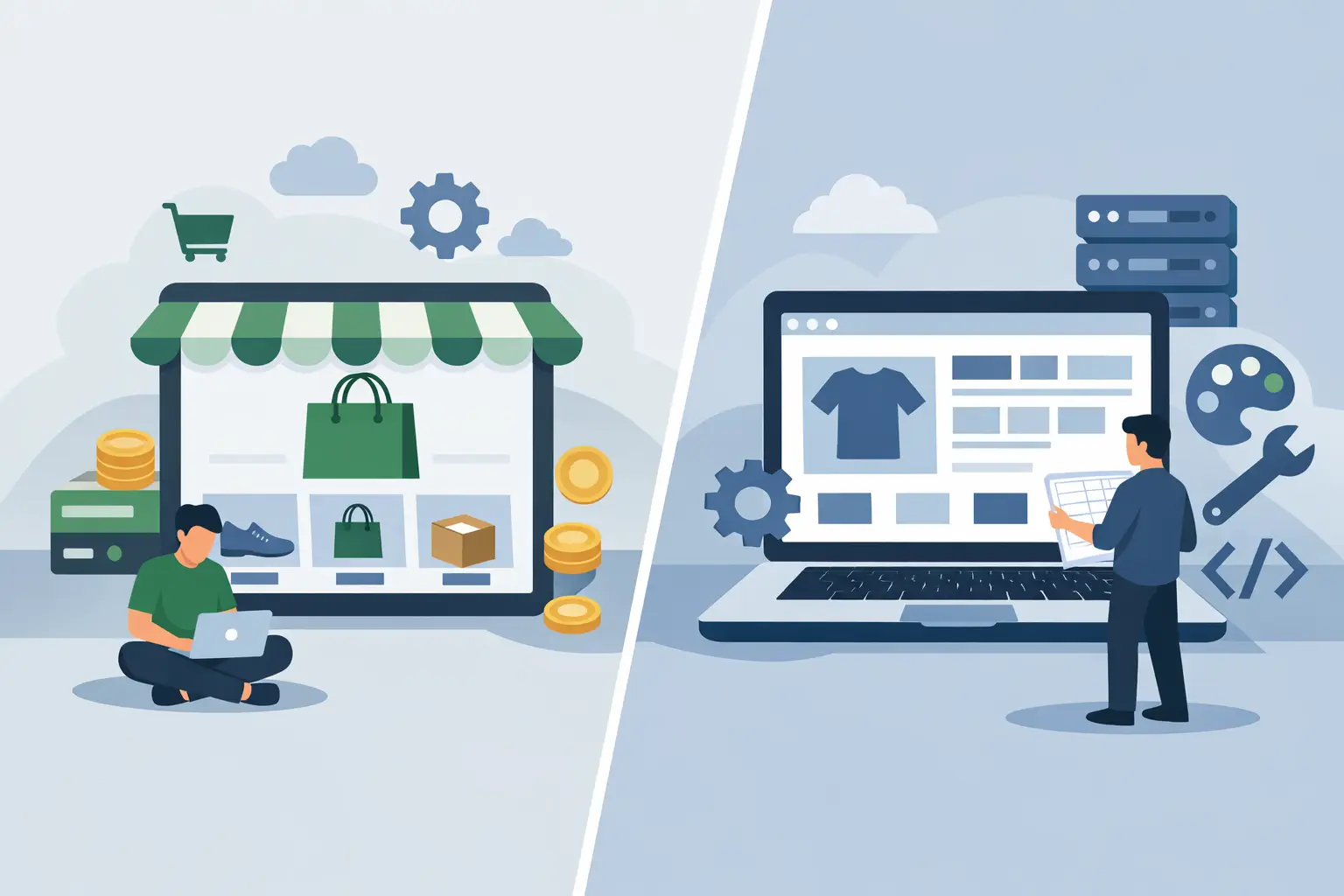
If you are deciding between Shopify vs custom ecommerce website options, the real question is not which one is better in general. It is which one fits the way your business sells, operates, and plans to grow. A store that needs to launch quickly with standard product workflows has very different requirements than a business that needs custom pricing, ERP integration, subscription logic, or account-specific buying experiences.
This is where many ecommerce projects go sideways. A company picks the platform that looks easiest at the start, then runs into limits six months later. Or it chooses a fully custom build when a simpler platform would have handled the job for less money and less maintenance. The right decision comes from understanding your business model, not just comparing feature lists.
Shopify vs custom ecommerce website: the core difference
Shopify is a hosted ecommerce platform. It gives you the storefront, checkout, product management, security updates, and hosting in one managed system. For many businesses, that means a faster launch, lower upfront cost, and fewer technical decisions.
A custom ecommerce website is built around your specific requirements. That can mean custom frontend design, custom backend logic, tailored checkout flows, integrations with internal systems, or all of the above. Instead of adjusting your business to match a platform, the site is built to match how your business already works or how you want it to work.
Neither option is automatically the smart choice. Shopify is efficient. Custom is flexible. The trade-off is usually between speed and control.
When Shopify makes the most sense
Shopify is a strong fit when your business needs to get online without turning the website into a major software project. If you sell physical products, have fairly standard shipping and tax rules, and want a system your team can manage day to day, Shopify can do that well.
It is especially useful for small to mid-sized businesses that need predictable costs and a shorter timeline. Product management is straightforward. Order handling is mature. There is a large app ecosystem, which means many common needs can be addressed without building from scratch.
For example, if you are a retailer, lifestyle brand, specialty food business, or nonprofit selling merchandise, Shopify can cover a lot of ground quickly. You can launch a polished store, connect payment processing, manage inventory, and start marketing without months of development.
The catch is that Shopify works best when your needs stay close to Shopify’s model. Once your pricing logic, customer workflows, or backend systems become more specialized, that convenience can start to narrow your options.
Shopify’s main advantages
The biggest advantage is speed. A well-planned Shopify project can move from design to launch much faster than a fully custom ecommerce build. That matters if you need revenue soon, want to validate demand, or are replacing an outdated site on a tight schedule.
The second advantage is lower technical overhead. Hosting, performance basics, PCI compliance, and platform maintenance are handled for you. Your team does not have to worry about patching infrastructure or managing a complex software stack.
The third advantage is usability. Shopify’s admin is built for merchants, not developers. If your internal team needs to add products, run promotions, and process orders regularly, the learning curve is usually manageable.
Where Shopify starts to feel limiting
App-based flexibility can be helpful, but it also has a ceiling. The more your store depends on third-party apps, the more moving parts you introduce. Subscription fees add up. Conflicts happen. Performance can suffer. And if one app handles a critical function, your business may be depending on a vendor you do not really control.
Customization is another common pain point. Shopify can be customized well, but there are boundaries around checkout, data structure, and platform logic unless you move into more advanced enterprise options. If your store needs highly specific user journeys or operational rules, you may spend more time working around the platform than benefiting from it.
When a custom ecommerce website is worth it
A custom ecommerce website makes sense when ecommerce is deeply tied to your operations, not just your catalog. If your pricing depends on customer type, contract terms, regional rules, quote requests, or inventory from multiple systems, a custom build may save time and money over the long run.
Custom is also the right path when the website needs to connect tightly with other business tools. That might include a CRM, ERP, accounting platform, warehouse system, donor database, field app, or membership portal. Once the ecommerce site becomes part of a larger digital ecosystem, flexibility matters more.
This approach is often right for manufacturers, wholesalers, B2B organizations, nonprofits with complex donation and merchandise workflows, and businesses with unique fulfillment models. It is not just about making the site look different. It is about making the system behave the way your business needs it to.
What you gain with custom
You get control over the user experience, business logic, and integrations. If you want a simplified quoting flow instead of a standard cart, that can be built. If certain customers need negotiated pricing, restricted products, or approval-based ordering, that can be built too. If your staff is currently doing manual work after every sale, a custom ecommerce system can reduce that friction.
You also get room to scale in a way that matches your business. A custom platform can be designed around your operational priorities from the start, rather than patched together as those needs appear.
What custom requires from you
Custom development takes more planning. It usually costs more upfront. It also requires clearer decision-making because you are defining workflows instead of selecting them from a platform menu.
That does not mean custom is risky by default. It means the project needs strong discovery, realistic scoping, and disciplined execution. Without that, custom can become expensive in the wrong places. With it, custom can solve problems that packaged platforms never fully address.
Cost is not just the upfront build
Many buyers compare Shopify and custom based only on launch cost. That is understandable, but incomplete.
Shopify usually wins on upfront affordability. You pay for design, setup, apps, and platform fees, and you can often spread those costs more gradually. For a business with simple needs, that is a practical advantage.
A custom ecommerce website usually requires a larger initial investment because the site architecture, features, and integrations are being built specifically for you. But long-term cost can shift depending on your needs. If you rely on many paid apps, custom workarounds, and manual staff processes to make Shopify fit, the total cost of ownership can rise faster than expected.
The better question is this: where will your business spend more over two to three years – platform fees and compromises, or custom development and support? The answer depends on complexity.
Timeline, risk, and internal capacity
If you need to launch in a matter of weeks or a few months, Shopify is often the safer route. The framework already exists, which keeps momentum high and reduces unknowns.
If you have the time to plan, document requirements, and build around long-term business needs, custom becomes more attractive. It can reduce downstream rework by addressing operational complexity earlier.
Internal capacity matters too. If your team wants a system they can update with minimal developer involvement, Shopify has a clear advantage. If your organization is comfortable working with a development partner for enhancements, support, and roadmap planning, custom can be a stronger strategic investment.
Shopify vs custom ecommerce website for growth
Growth changes the equation. A small catalog with direct-to-consumer sales may do very well on Shopify for years. But growth does not always mean more traffic and more products. Sometimes it means more locations, more user roles, more data, more integrations, and more exceptions.
That is usually the point where businesses outgrow platform convenience. They start needing account-based portals, custom shipping rules, sales rep ordering tools, advanced filtering, or process automation tied to fulfillment and finance. Those are not cosmetic upgrades. They affect how the business runs.
For organizations with those requirements, a custom ecommerce website is not a luxury. It is infrastructure.
How to make the right call
Start with your operations, not your wishlist. Look at how products are managed, how orders are fulfilled, how pricing is set, what systems need to connect, and what your team handles manually today. Then look at where the business expects to be in two years.
If your store can succeed with standard ecommerce patterns, Shopify is often the practical choice. It is efficient, proven, and easier to manage.
If your ecommerce site needs to support specialized workflows, custom integrations, or a broader digital system, a custom build is usually the better long-term decision. That is especially true when the website is expected to reduce staff workload, support multiple user types, or act as a central business tool.
At codepxls, we have seen both paths work well when the decision is grounded in real business needs instead of assumptions. The best ecommerce platform is the one that fits your process, your budget, and your next stage of growth without creating avoidable friction later.
Before you choose, take a hard look at what your business actually needs the site to do after launch. That is usually where the right answer becomes clear.