
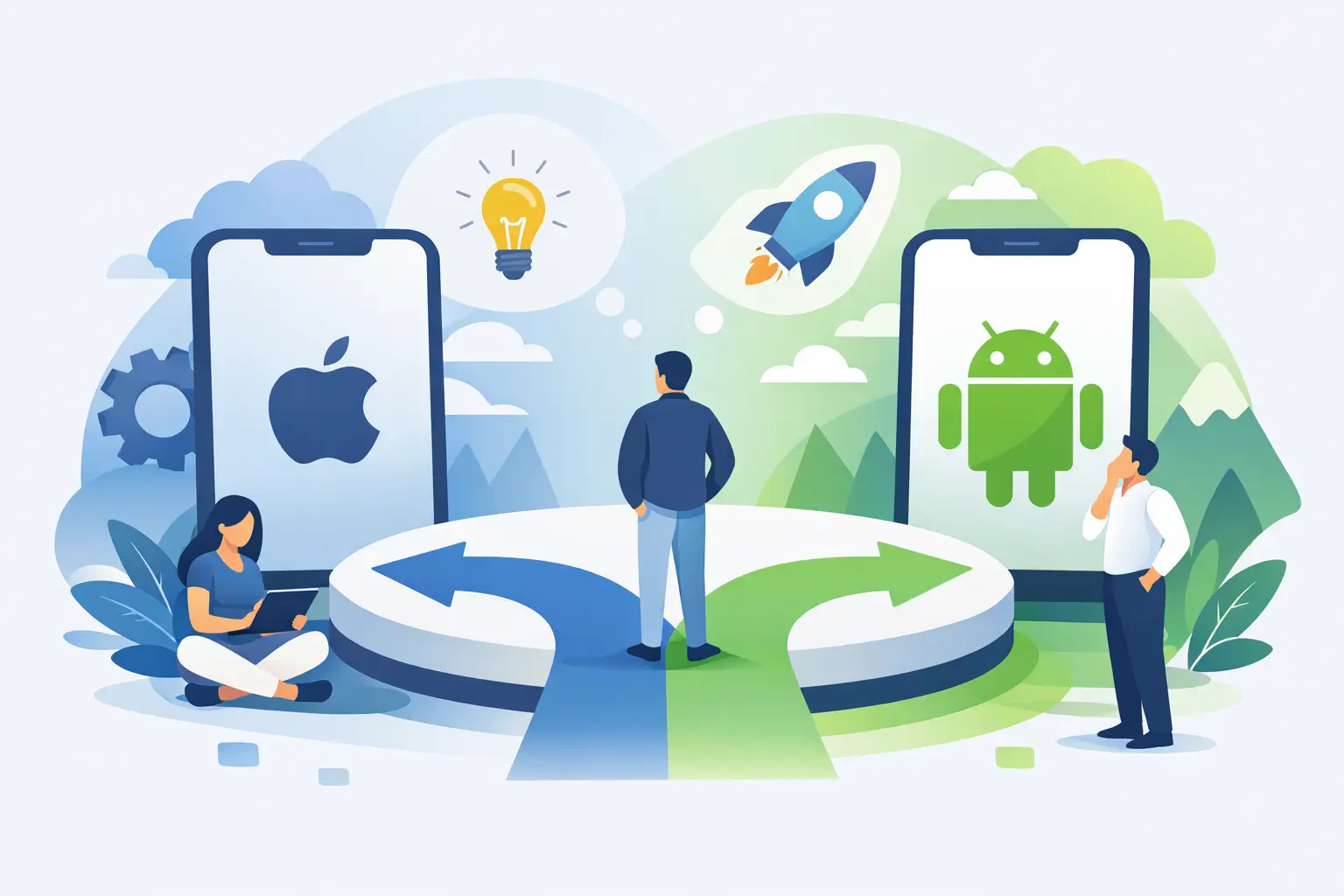
One of the first real decisions in mobile development is not design or features. It is whether to build an iOS or Android app first. For most organizations, this choice affects budget, timeline, user adoption, support needs, and how quickly the app starts delivering value.
If you are a startup chasing early traction, a nonprofit serving a broad community, or an established business trying to improve operations, there is no universal answer. The right platform depends on who your users are, what the app needs to do, and what kind of launch you can realistically support.
How to choose iOS or Android app first
The simplest way to make this decision is to stop thinking about market share in the abstract and start looking at your audience. A business app for internal staff has different priorities than a consumer app. A paid subscription product has different economics than a free engagement app. A field service tool used on company-issued devices has different constraints than a public-facing app expected to work across a wide mix of phones.
When clients ask this question, the best answer usually comes from five practical areas: audience, revenue model, device environment, budget, and launch risk. Those factors matter more than broad assumptions about which platform is better.
Start with your actual users
If your users are mostly professionals, higher-income consumers, or customers already engaged through Apple devices, iOS may be the smarter first release. iPhone users often show stronger spending behavior in certain categories, especially subscription services, premium consumer products, and business-oriented apps.
If your users are more geographically diverse, price-sensitive, or spread across a wider range of devices, Android may be the better starting point. Android has broader global reach and often makes more sense for organizations trying to maximize accessibility and distribution.
This is where many teams overcomplicate the issue. You do not need a perfect prediction. You need a defensible starting point based on the people most likely to use the app first.
When iOS should come first
There are solid business reasons to launch on iOS first. The first is device consistency. Apple has fewer device types and operating system variations to account for, which often makes development, testing, and quality control more straightforward. If your goal is a tighter first release with fewer unknowns, iOS can reduce complexity.
The second is monetization. If the app will depend on subscriptions, in-app purchases, or paid downloads, iOS can be attractive because Apple users tend to spend more in many verticals. That does not mean Android users do not convert. It means the early revenue pattern is sometimes easier to prove on iOS.
The third is speed to market for a polished MVP. If you need to validate an idea quickly, especially with a limited budget, starting with one platform that is easier to standardize can be the most efficient path.
iOS-first is often a strong fit for startups, membership organizations, professional services, and brands targeting a narrower but higher-value user base.
When Android should come first
Android makes more sense when reach matters more than early premium conversion. If your app is meant for a broad public audience, community outreach, education, logistics, or service delivery at scale, Android can be the practical choice.
It also matters when your users already rely on Android devices. This is common in field teams, distributed workforces, and cost-conscious organizations. If employees, volunteers, or customers are already on Android, forcing an iOS-first strategy can delay adoption instead of accelerating it.
Android can also be the right first step when hardware integrations, custom device deployments, or specific operational workflows are involved. In some business environments, Android offers more flexibility.
The trade-off is that Android development and testing often require more attention across screen sizes, manufacturers, and OS versions. That does not make it a poor choice. It just means the planning needs to be realistic.
Budget changes the answer
A lot of teams ask whether they should build both platforms at once. Sometimes that is the right move. Often it is not.
If your budget is tight, picking one platform first is usually more responsible than trying to split resources across two launches. A rushed release on both platforms can create more damage than a strong launch on one. Poor reviews, support problems, and unstable performance are expensive to fix after the fact.
A single-platform launch gives you room to test onboarding, refine features, gather feedback, and confirm usage patterns before scaling development further. That approach is especially useful when the app connects to a website, CRM, internal dashboard, or backend system that also needs attention.
This is where an experienced development partner can make a real difference. The decision is not just about the app itself. It is about the full system around it and what your team can support after launch.
Native first or cross-platform first?
The iOS or Android app first question is often tied to another one: should you build natively or use a cross-platform framework?
If performance, hardware access, or platform-specific experience is central to the product, native development may be worth the extra investment. If the goal is to launch efficiently on both platforms with a shared codebase, a hybrid or cross-platform approach can be a smart middle ground.
There is no one-size-fits-all answer here either. Cross-platform can lower upfront cost and speed up delivery, but it needs to be planned well. Native can offer stronger optimization, but it may not be necessary for every project. The right call depends on feature requirements, timeline, and how much platform-specific behavior matters.
Look at your data before you guess
If your business already has website traffic, email engagement, CRM records, or customer analytics, use them. Device and browser data can point you toward the platform your audience already prefers.
For example, if most of your mobile visitors come from iPhones, that is useful evidence. If your internal users are mostly on Android tablets, that matters too. If your customer base is split evenly, the decision may come down to budget, feature complexity, and rollout strategy rather than audience preference alone.
This is a practical planning step that gets skipped too often. Good app decisions should come from usage patterns, not assumptions.
The hidden factor is support after launch
Launching the app is only part of the project. Updates, bug fixes, OS changes, app store requirements, user feedback, and ongoing improvements are what turn a launch into a usable long-term product.
That is why the platform decision should also reflect what your organization can maintain. If your internal team is small and your app is tied to business operations, it may be smarter to start with the platform that gives you the smoothest support path. If your rollout includes backend integrations, user management, and future feature phases, those dependencies should influence the order of development.
A dependable launch is usually better than an ambitious one that strains your team immediately.
A simple way to make the call
If your users are likely to be iPhone-heavy, your app depends on subscriptions or premium engagement, and you want a more controlled first release, start with iOS.
If your audience is broader, more device-diverse, operationally focused, or already concentrated on Android, start there.
If both platforms are equally important and budget allows, consider a cross-platform build with a clear rollout plan. Just make sure the technical approach supports the quality level your users expect.
What matters most is not picking the universally best platform. It is choosing the right first platform for your goals, your users, and the systems the app needs to support. That is the kind of planning that saves money, avoids rework, and leads to a stronger product.
At codepxls, we see the best outcomes when organizations treat this decision as part of a larger digital strategy, not a coin flip between Apple and Android. If you start with the audience, define the business outcome clearly, and build in a way your team can sustain, the first platform becomes much easier to choose.
A good app launch starts with the right priorities, not the broadest wish list.