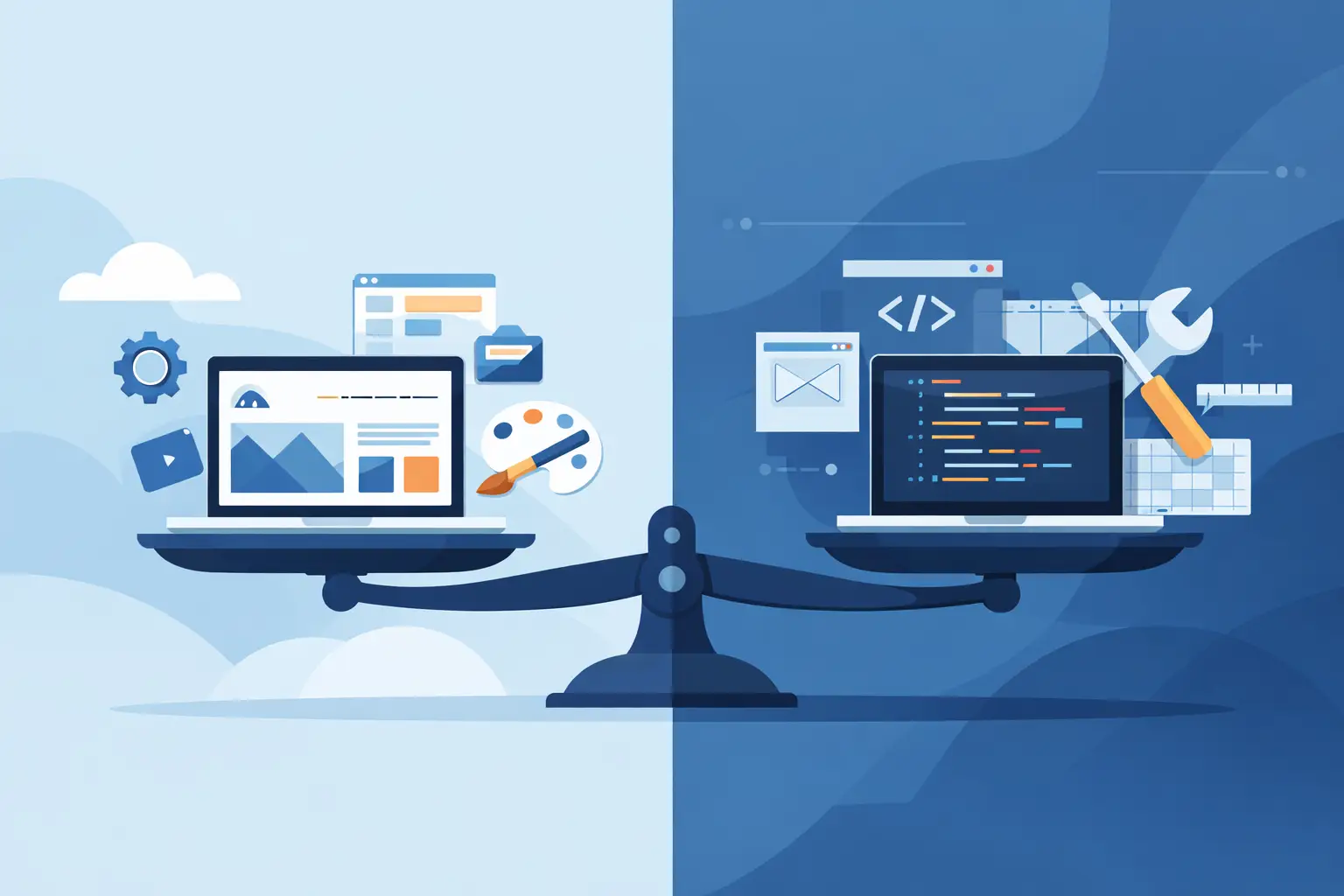
A lot of website projects go off track before design even starts. The problem is not color choices or page layouts. It starts when a business picks the wrong foundation. If you are weighing wordpress vs custom website options, the real question is not which one is better in general. It is which one fits your goals, timeline, budget, and internal workflow.
For some organizations, WordPress is the smart move because it gets a solid site live faster and gives non-technical teams more control. For others, a custom website is the better investment because the site needs to do more than publish content and collect form submissions. The right answer depends on how your business operates and what your website is expected to handle six months and two years from now.
WordPress vs custom website: the core difference
WordPress gives you a content management system with a large ecosystem of themes, plugins, and integrations. It is a practical choice for marketing sites, nonprofit websites, service-based businesses, blogs, and many standard brochure-style builds. You can move quickly, manage content internally, and avoid reinventing common features.
A custom website is built around your exact requirements. That can mean a custom front end, a tailored backend, or a complete web application with unique workflows, database logic, API connections, and user roles. Instead of adapting your business to fit a platform, the platform is built to fit your business.
That difference matters. If your website mainly needs to inform, persuade, rank, and convert, WordPress often covers the ground well. If your website needs to support complex business rules, advanced user experiences, or connections to internal systems, custom development usually makes more sense.
When WordPress is the better business decision
WordPress works best when speed, usability, and budget discipline matter more than custom engineering. Many small to mid-sized companies do not need a fully custom system. They need a professional site that looks credible, loads well, supports SEO, and gives their team an easy way to update pages, post news, and manage campaigns.
That is where WordPress is hard to beat. It is familiar, flexible, and cost-effective when handled correctly. A well-built WordPress site can support lead generation, event calendars, donation pages, landing pages, location pages, and basic e-commerce without requiring a ground-up build.
It is also a strong fit for nonprofits and growing organizations that rely on staff members to make routine updates. If your communications team needs to publish content without opening a support ticket every time, WordPress creates less friction.
Still, there are trade-offs. WordPress can become bloated when too many plugins are stacked together to force advanced functionality. Maintenance also matters. Updates, security monitoring, plugin compatibility, and performance tuning are not optional if the site is business-critical.
When a custom website is worth the investment
A custom website makes sense when your site is part of a larger operational system, not just a digital brochure. If the project includes account dashboards, advanced filtering, custom databases, booking logic, gated content, multi-step workflows, CRM syncing, or business-specific automation, custom development often prevents future headaches.
This is especially true when off-the-shelf tools create compromises. A plugin might technically do the job, but if it slows the site down, creates a clunky admin experience, or forces your team into workarounds, the cheaper option can get expensive over time.
Custom websites also give you tighter control over performance, architecture, and user experience. You are not locked into a theme structure or trying to patch together ten different third-party tools. That control is valuable when your website needs to scale or when user behavior and conversion paths matter enough to warrant precision.
The downside is obvious. Custom development usually costs more upfront, takes longer to plan and build, and requires a team that understands both software logic and user experience. It is not the right fit for every project, especially if the site requirements are straightforward.
Budget is not just about the launch price
One of the biggest mistakes in the wordpress vs custom website decision is focusing only on initial cost. Launch cost matters, but long-term cost matters just as much.
WordPress usually wins on lower upfront pricing. That makes it attractive for startups, nonprofits, local service businesses, and organizations that need a professional web presence without a large capital investment. But if the site eventually needs heavy customization, custom user flows, or multiple system integrations, the cost of retrofitting WordPress can climb quickly.
Custom websites often require a higher initial budget, but they can reduce inefficiency when the website is central to how your organization operates. If a custom build saves staff time, removes manual data entry, improves lead handling, or supports a better customer experience, that investment may pay off faster than expected.
This is where a clear discovery process matters. The right team will help you map current needs, likely future needs, and the real cost of either path before development starts.
Content management and internal control
For many organizations, the deciding factor is not design. It is usability after launch.
WordPress is built for content management. That means marketing managers, nonprofit staff, and business owners can usually learn the system quickly. Publishing blog posts, editing service pages, updating staff bios, and swapping images is straightforward when the site is set up properly.
Custom websites can also include content management tools, but that experience depends entirely on how the system is designed. A well-planned custom CMS can be excellent. A poorly planned one can make simple edits harder than they should be. If your team needs frequent hands-on access, this part of the conversation should not be treated as a minor detail.
In practice, if content publishing is a core part of your workflow, WordPress often has the advantage. If the site is more application-driven and less content-driven, custom tools may serve your team better.
Performance, security, and maintenance
Neither option is automatically better here. Execution matters more than the label.
A poorly built custom website can be slow, hard to maintain, and risky. A poorly managed WordPress site can be just as problematic. The difference is that WordPress has more common attack vectors because of its popularity and plugin ecosystem, so maintenance discipline is essential.
With WordPress, the key is selective development. Fewer plugins, better hosting, clean implementation, and routine updates usually produce a much healthier site. With custom builds, the focus shifts to code quality, infrastructure planning, security reviews, and long-term support.
For business owners, the practical question is simple: who is maintaining this after launch? A dependable support plan often matters more than whether the site started in WordPress or as a custom application.
Which option scales better?
Scaling means different things to different organizations. Sometimes it means adding more content, more traffic, and more landing pages. In that case, WordPress can scale very well when the build is done right.
Other times, scaling means adding custom functionality, user accounts, integrations, advanced reporting, or workflow automation. That is where custom architecture tends to hold up better. It gives you room to expand without constantly fighting the limits of a general-purpose CMS.
This is why the right choice often comes down to what the site may become, not just what it is on day one. A company planning to connect its website to a CRM, mobile app, inventory system, or proprietary backend should think beyond launch speed.
How to make the right call
If your website’s main job is to market your business, publish content, support SEO, and generate leads, WordPress is often the practical answer. It is efficient, proven, and easier for internal teams to manage.
If your website needs custom workflows, system integrations, tailored functionality, or room to grow into a more advanced digital platform, custom development is usually the stronger long-term choice.
There is also a middle ground. Some projects use WordPress for content management while layering in custom functionality where the business actually needs it. That hybrid approach can control costs without boxing you into a rigid setup. For many growing organizations, that is the most sensible path.
At codepxls, this is usually where the conversation becomes useful. Not at the point of selling one platform over another, but at the point of matching the build to the actual business need.
A website should make your work easier, not create new maintenance problems. If you start with that standard, the right platform choice becomes a lot clearer.